
Featured

Blogging Tutorial: How to Use the Hero’s Journey for Blog Post Creation

This blogging tutorial walks you through using the hero’s journey to plan your wellness blog content.

This blogging tutorial for wellness bloggers covers a framework you can use to align your content with your target customer’s needs, ensuring to address them and solve their problems, leading to a relationship based on trust. Your target customers will see you as an expert in your field, and the law of reciprocity will kick in, leading your target customers to buy from you. Some marketers refer to leveraging reciprocity as “reciprocity marketing”. You can read more about reciprocity marketing in this article by B2C.

Here’s why you should align your blog with the hero’s journey.

Using the Hero’s Journey as an outline for your blog gives you a script to stick to,

aligning your buyer persona’s problems with blog posts,

so you have a solid strategy for your content.

You provide more value for your customers when you focus your content.

Photo by eberhard grossgasteiger on Pexels.com

The Hero’s Journey is a valuable tool for wellness bloggers because it aligns your content with your target customer’s needs. By addressing their needs over time, you will create a relationship built on trust; your target customer will view you as an expert who can solve their problems so you can convert your readers to customers. Moreover, following this outline allows you to help more people.

In this post, we’ll answer the following:

  • What’s the difference between the hero’s journey and the customer journey?
  • What is the hero’s journey?
  • Why is the hero’s journey important for wellness bloggers?
  • How can I use the hero’s journey to outline my blog?

**And you’ll get to see the process from start to finish, while I demonstrate how to plan your content using an example of a Reiki blog for people with permanent injuries.

*If you read my last blogging tutorial, you might be wondering why this post is covering the Hero’s Journey, instead of the Customer Journey. Embarrassingly, I used the wrong term. While both are important, here’s the difference.

Hero’s Journey vs. Customer Journey

When blogging, we use the hero’s journey to understand what our prospect is experiencing, so we can metaphorically meet them where they are. We use the hero’s journey to solve our customer’s problems.

On the other hand, we use the customer journey to plan the customer’s journey through checkout. From determining they have a problem to deciding to purchase from you, your customer takes a journey.

For example, your customer journey might start with bait in Pinterest that takes your customer to your Instagram page, where she finds your quick tips. As she progresses, you inevitably sign her up as a coaching client or patient.

But, the customer journey also includes processes following the initial purchase. You’ll plan to continue providing value, and you’ll determine what your customer needs now. Then, you’ll repeat the product creation process as you scale your wellness brand.

Here’s a Customer Journey sample map.

Now, let’s get to the topic of our discussion- the hero’s journey.

What is the Hero’s Journey, and Why Does it Matter?

The Hero with a Thousand Faces, by Joseph Campbell, was the first book about the hero’s journey released. Campbell studied ancient myth and literature and discovered a pattern that all stories followed. The Around the Campfire YouTube channel describes the hero’s journey in its simplest form: The hero travels to retrieve something and returns. 

Around the Campfire reminds us that, although some writers perceive the hero’s journey as a highly restrictive rulebook to be followed to the T, it is more of a guide for creating a story that:

  • Makes readers feel comfortable with the author
  • Lures the reader with familiar tropes that are ever-present in the genre.
  • Surprises the reader and delights her with its twists and turns.

What is a trope?

In literature, a trope is typically a metaphor or phrase commonly used in a genre. Study.com explains tropes in this video. Check it out if you want to dig deeper into the topic of tropes. In the video, Study.com uses the trope example- “Stop and Smell the Roses.”

Around the Campfire identifies tropes as an asset to a writer. Without knowing the usual tropes in a genre, the content is missing the piece that makes the reader feel at home with the story. When a story includes familiar phrases and metaphors, the reader becomes comfortable with the content because they have repeatedly heard the term or analogy.

The three main phases in the hero’s journey.

  • Departure
Image of two superhero's walking in the subway.

Starting out, everything is normal for the main character.

Then there is a call to adventure, which the character initially refuses. Enter the mentor or sage, and the protagonist crosses the threshold from known to unknown.

  • Initiation

In the marketing world, this is where the transformation occurs. The main character faces challenges, including the belly of the beast- the most challenging part of the protagonist’s journey.

  • Return

In the return, the main character faces the ordeal, reaps the rewards, heads back to share his story with others, and is redeemed.

Below is an example of a hero’s journey.

Buyer Persona/Hero: Pam-A woman with permanent injuries.

  • Departure

Everything is normal until a permanent injury leaves Pam devastated. She can no longer live the way she is accustomed to living.

Challenges:

  • Mobility is severely impaired.
  • Pain medications complicate the woman’s life. She no longer feels like she thinks clearly, and she worries about the lifelong consequences of strong medicines.
  • Her mental well-being is poorly affected by her new physical and cognitive limitations.
  • Call to adventure

Pam meets a woman who received Reiki treatments that improved her lifestyle after suffering the devastating effects of her permanent injury. She tells Pam that her Reiki practitioner is taking new clients and suggests Pam make an appointment. However, Pam is reluctant because she is unsure if it works, and she isn’t sure if it will work for her (these are common obstacles for your clients).

  • Initiation

As Pam’s friend continues to see results from her Reiki treatments, Pam falls into despair over her limitations, and she loses the sense of self she once had. Then, things get worse, and Pam is now addicted to pain medication. She is devastated and feels ashamed that it’s come to this!

She resolves to face and overcome her challenges, so she makes an appointment with her friend’s Reiki practitioner. And the seeds of her transformation are planted!

  • Return

Pam continues making appointments with the Reiki practitioner, Bob. Bob works with Pam on resolving her mental and physical health problems. And he enlists her in a Reiki program for clients who are addicted to pain medications but don’t know how to live their life without them.

As a result, Pam’s mobility increases. When she first started seeing Bob, she couldn’t even do her grocery shopping. She couldn’t handle the walk around the store, and her weight restrictions made it difficult to pick up and handle items.

But, after just a couple of treatments, Pam can use her grocery shopping as her weekly long walk. Then, she adds a short walk to her schedule three times a week. Then, four, etc. The distance she can walk gradually increases, and she notices that her joints feel less stiff. And she is feeling better!

Her mental well-being improves through Bob’s prescribed meditation exercises and her new-and-improved mobility. But the most critical improvement Pam experiences is that she breaks free of her chains to prescription pain medications. She no longer needs to take them all day, and her addition of Reiki and meditation to her routine helps her work through the energies surrounding her addiction.

Once Pam sees these results, she starts spreading the word about Reiki. And the hero’s journey begins again with a new hero.

 How to Use the Hero’s Journey to Answer Your Prospect’s Questions

Using the hero’s journey to answer your prospect’s questions allows you to:

  • connect with them
  • solve their problems
  • build rapport by offering an intriguing and high-quality blog
  • convert the prospect to a client.

Since most literary work applies the hero’s journey, we know that blog posts can benefit from it- especially if you use it to help your client solve her problems.

Here’s how I would align Pam’s hero’s journey with a blog. After reading this, you’ll have an inkling of how to align your buyer persona’s hero’s journeys with your blog.

  • Blog Post #1: Address the challenges Pam experiences in the ‘departure’ stage.
  • Write blog post #1 about mobility challenges and how to overcome them.
  • Blog Post #2: Continue addressing the challenges Pam experiences in the ‘departure’ stage.
  • Write blog post #2 about pain medications and their cognitive effects. Additionally, this post should offer Pam consolation for what she is experiencing and offer solutions.
  • Blog Post #3: Continue addressing the challenges Pam experiences in the ‘departure’ stage.
  • Write blog post #3 about the lifelong consequences of various pain medications. Be sure to include reliable sources of research and statistics in every post that supports your claims. Also, remind your readers that they should always follow their doctor’s advice, but that doesn’t mean they cannot ask the doctor for options other than medication.
  • Offer solutions for two scenarios- those who want to talk to their doctor about their options and those who wish to continue taking their medications while adding unconventional therapies, like Reiki, to their treatment regimen.
  • Blog Post #4: Continue addressing the challenges Pam experiences in the ‘departure’ stage.
  • Write blog post #4 about Pam’s mental wellbeing. Research has repeatedly linked one’s physical health and cognition. Addressing mental well-being while addressing the other characteristics of Pam’s suffering can boost your client’s treatment efficacy. A recent study by Cronly et al. screened 147 people in Ireland for depression and anxiety to ascertain and promote well-being and positive mental health. The study’s authors found a significant correlation between wellbeing and positive mental health. They concluded that promoting wellbeing and positive mental health helps patients in many ways. One of which is improving mental and physical health and health-related quality of life.
  • Plus, remember that Pam needs to know that she is not a freak- everything she is experiencing, others have also experienced. If you want to provide an even more significant impact for Pam, draft some anonymous stories about clients you have helped. Include stories that start with as many of the problems that Pam is experiencing as possible. Focus on stories with the most remarkable improvement, and your customers will feel empowered and motivated to improve.
  • Blog Post #5 is where you might move on and address the ‘call to adventure’ stage.
  • This is where you introduce your product or service as a solution to Pam’s problems. The best way to do this is to share a customer success story with a hero like Pam, who overcame her obstacles. Add medical research that supports your claims. Doing this allows you to address one of the common obstacles clients face– does it work?
  • Blog Post #6, 7, and 8: Address the ‘call to adventure’ stage.
  • Keep authoring stories of how your service addresses Pam’s problems.
  • Blog Post #6: Address one of the challenges and include a success story.
  • In the case of a Reiki blog, one might write about how Reiki helped someone with their pain. This allows Pam to compare herself to others and addresses another common obstacle clients face- will it work for me?
  • Blog Post #7: Write about how Reiki solved someone’s mobility issues.
  • Once again, use one of your customer success stories. If you are new to your practice and don’t have any customer success stories, search for stories from a reliable online source. For example, a Reiki practitioner might include a story from one of the Reiki informational sites with a high authority score.
  • Blog Post #8: Write about how Reiki healed someone’s addiction to pain medications.
  • Ensure to remind your client of the cognitive improvement they will make once they are not a slave to pain medication. Offer support. You can do this in your call to action.
  • Blog Post #9, 10, 11, and 12 could be grouped as a series.
  • In this example, you might choose to write a series about guided meditations infused with Reiki.

5 Tips and Reminders for Using the Hero’s Journey to Design Your Blog

Always have a call to action!

A call-to-action can be as simple as asking a question at the end of your blog post. Or it could be inviting your prospect to a one-on-one call. Remember, your prospect’s degree of commitment is likely to increase the longer she reads your content.

A recent study by Sánchez-Garcés et al. proved the correlation between a prospect’s number of engagements with a brand and the prospect’s probability of purchasing. Further, the study results show how the authors led their customers through the customer journey, in which social media and other online mediums were used to communicate information to the prospect regarding the product. They observed 1088 internet users in their pre-test period and 1450 users in their post-test period.

The results of the study included:

  • A 36.25% efficiency increase relevant to customer conversions per session.
  • A 46.43% increase in visits to the channel

The study authors concluded that using digital channels to communicate information to prospects allows brands to receive feedback throughout the customer journey. The ability to participate in two-way conversations with prospects allows marketers to nurture the prospect

Note that you will continue addressing Pam’s initial challenges until you are well into your content “season.”

Like a television show, I like to group my blog posts into seasons. I got the idea when I recorded my first podcast season. You can check out my Meditation for Marketers Podcast to see what I mean if you need a visual.

If you choose to group your blog posts into seasons, follow these tips to simplify and improve the efficacy of your content.

Each season has 12 weeks.

This allows you to create pillar content that answers the most frequently asked questions your target customer has, so you can update and upgrade it every season.

Or you can use your seasons to hyper-focus on specific topics, like meditation.

Write at least one post per week.

Since you will need to use social media as well, you could write a blog post per week and add some other form of content once a week that makes your brand stand out. For example, a podcast provides the choice of reading or listening.

The essential thing to do for the last four blog posts is to switch it up.

Stay on brand but break the monotony a bit by adding challenges or something like them to engage your audience. Challenges have been all the rage lately, and they are inherently effective at moving people through the customer journey.

Pedro Adao, deemed the King of the Modern Challenge by his peers, is one marketer who leveraged challenges for success. Once he found the best template for challenges, he started sharing it with other marketers.

I had the pleasure of watching Pedro at the 2020 Traffic and Conversion Summit, and he made a lot of good points. I urge you to check out Pedro’s bio, linked above, and explore how challenges can make or break your brand.

If, by blog post #9, you are comfortable adding podcasting or a YouTube channel to your blog, do it.

Podcasts and videos are great for clients who don’t want to read, and it gives your clients options. According to Vyond, video can increase your marketing ROI. Your prospects are watching around 16 hours of videos online every week. It captivates them, engages them, and boosts your SEO.

If you chose to add a podcast, you could use the last four episodes of your blog season to ease your audience into your podcast as an alternative to a blog post. 

In conclusion, using a hero’s journey as a guide for blog creation is a great idea. It enables you to solve your customers’ problems, which builds their faith in you. The further you can get into your client’s mind, the better you will understand their hero’s journey, resulting in targeted content that gets results.

If you like this post, you should check out this post

The above is a blogging tutorial that walks you through

  • creating the map of your website using Answer the Public’s keyword research tool. That way, you get more eyes on your blog and help more people!

What’s next?

My next wellness blogger tutorial will address:

Specializing in Building Rapport with Prospects

Search Intent Explained: How to Match Content to Rankings

If your content isn’t ranking, the problem often isn’t your writing—it’s search intent.

Search engines don’t rank pages based on effort or word count. They rank pages based on how well the content matches what the searcher actually wants.

This guide explains what search intent is, why it matters for SEO, and how to match your content to intent so it ranks.


What Is Search Intent?

Search intent is the reason behind a search query.

When someone types a phrase into Google, they’re trying to:

  • Learn something
  • Compare options
  • Complete an action

Search engines prioritize content that best satisfies that goal.

If your page doesn’t match the intent—even if it’s well-written—it won’t rank.


Why Search Intent Matters for SEO

Google’s goal is simple: deliver the best possible result for every query.

If users click your page and leave quickly, that’s a signal your content didn’t meet expectations. Over time, pages that consistently satisfy intent rise in rankings.

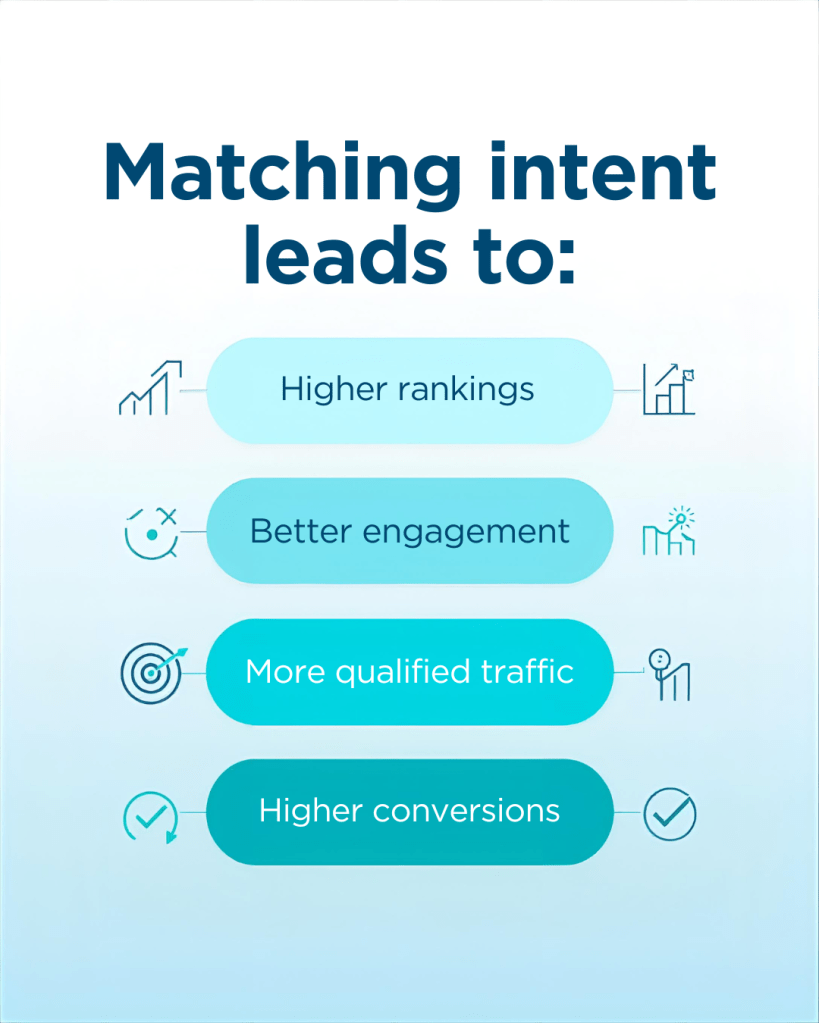
Matching intent leads to:

  • Higher rankings
  • Better engagement
  • More qualified traffic
  • Higher conversions

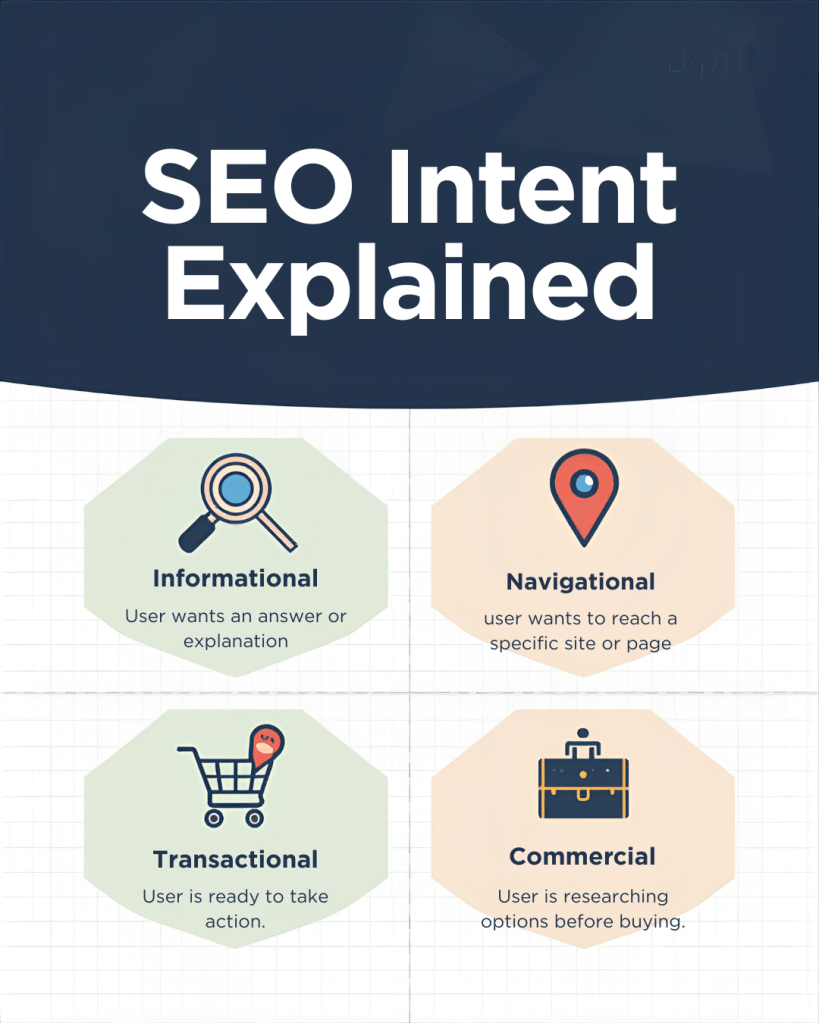
The Four Main Types of Search Intent

Most searches fall into one of four categories.


1. Informational Intent

The user wants an answer or explanation.

Examples:

Best content types:

  • Blog posts
  • Guides
  • Tutorials
  • Explainer articles

Goal: Educate clearly and thoroughly.


2. Navigational Intent

The user wants to reach a specific site or page.

Examples:

  • “Google Search Console login”
  • “WordPress dashboard”

Best content types:

  • Brand pages
  • Login or homepage links

Goal: Help users get where they want to go (this usually isn’t blog content).


3. Commercial Intent

The user is researching options before making a decision.

Examples:

  • “Best SEO content tools”
  • “Content marketing services for small businesses”
  • “SEO writer vs copywriter”

Best content types:

Goal: Help users evaluate and choose.


4. Transactional Intent

The user is ready to take action.

Examples:

  • “Hire SEO content marketer”
  • “Buy keyword research tool”

Best content types:

  • Sales pages
  • Landing pages
  • Product pages

Goal: Convert.


How to Identify Search Intent (Step-by-Step)

You don’t need fancy tools to identify intent. Start with the search results.

Step 1: Google the Keyword

Search your target keyword and look at:

  • Page titles
  • Content format
  • Type of pages ranking

Ask:

  • Are the results mostly blog posts or product pages?
  • Are they guides, lists, or comparisons?

Google is already showing you what intent it favors.


Step 2: Look for Patterns

If most results are:

  • Long guides → informational intent
  • “Best” lists → commercial intent
  • Service pages → transactional intent

Your content should match that pattern.


Step 3: Check the Language Used

Intent clues are often in the wording:

  • “How to” → informational
  • “Best” or “Top” → commercial
  • “Hire” or “Buy” → transactional

How to Match Content to Search Intent

Once you know the intent, your content should reflect it from top to bottom.


Match the Content Format

If search results are:

  • Guides → write a guide
  • Lists → write a list
  • Comparisons → write a comparison

Trying to rank a sales page for an informational keyword won’t work.


Match the Content Depth

Don’t overdo or underdeliver.

  • Simple questions need clear answers
  • Complex topics need structured depth

Look at the average length and coverage of ranking pages and aim to be more helpful, not just longer.


Match the CTA to the Intent

This is where many pages fail.

Examples:

  • Informational post → link to related guides or resources
  • Commercial post → link to case studies or services
  • Transactional page → clear conversion CTA

Your call-to-action should feel natural, not forced.


Common Search Intent Mistakes

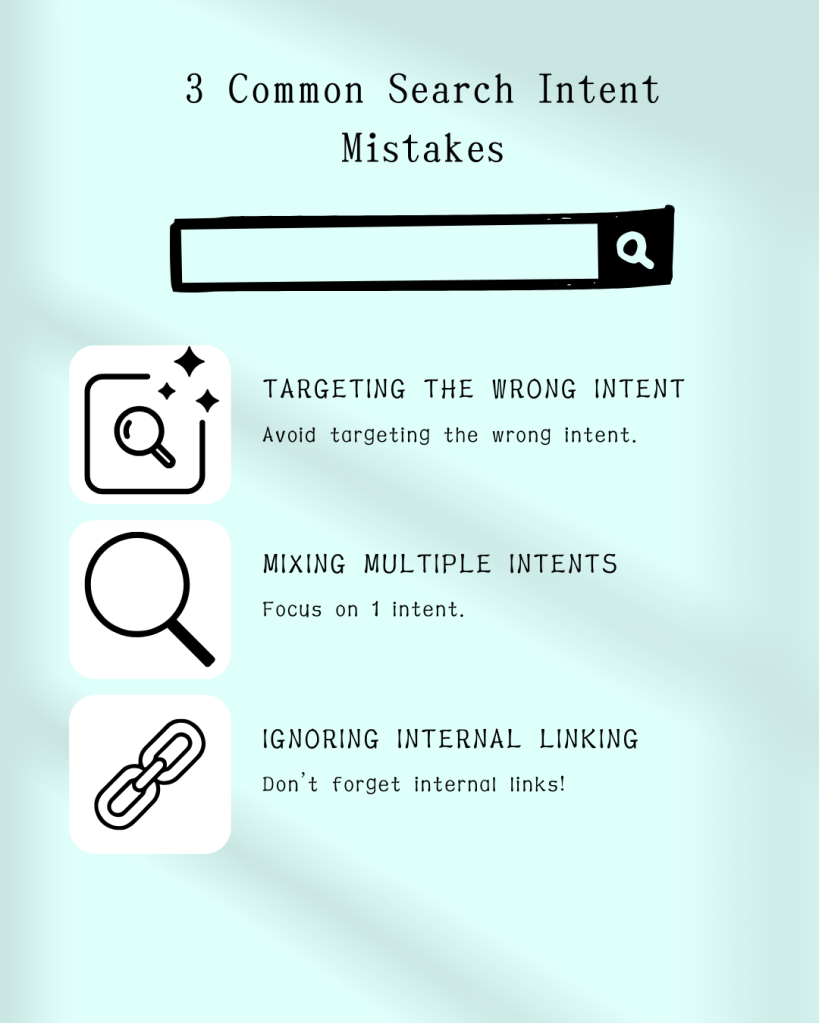
Targeting the Wrong Intent

Writing a blog post when Google favors service pages—or vice versa.

Mixing Multiple Intents

Trying to educate, sell, and compare all in one post.

Ignoring Internal Linking

Not guiding users to the next logical step based on intent.


Search Intent and Content Strategy

Search intent should guide:

  • Topic selection
  • Content format
  • Internal linking
  • Conversion paths

When combined with keyword research and strong writing, intent alignment turns content into a ranking asset, not just a blog post.


Search Intent Is the Difference Between Ranking and Not Ranking

SEO content success isn’t about tricks or hacks. It’s about understanding users.

When your content:

  • Answers the right question
  • In the right format
  • At the right time

Search engines reward it.


Next Steps

If you’re building an SEO content strategy, start by auditing your existing posts:

  • Do they match search intent?
  • Do they guide users forward?
  • Do they support your core pillars?

Explore more resources in the SEO Content Marketing pillar to build content that ranks—and keeps ranking.

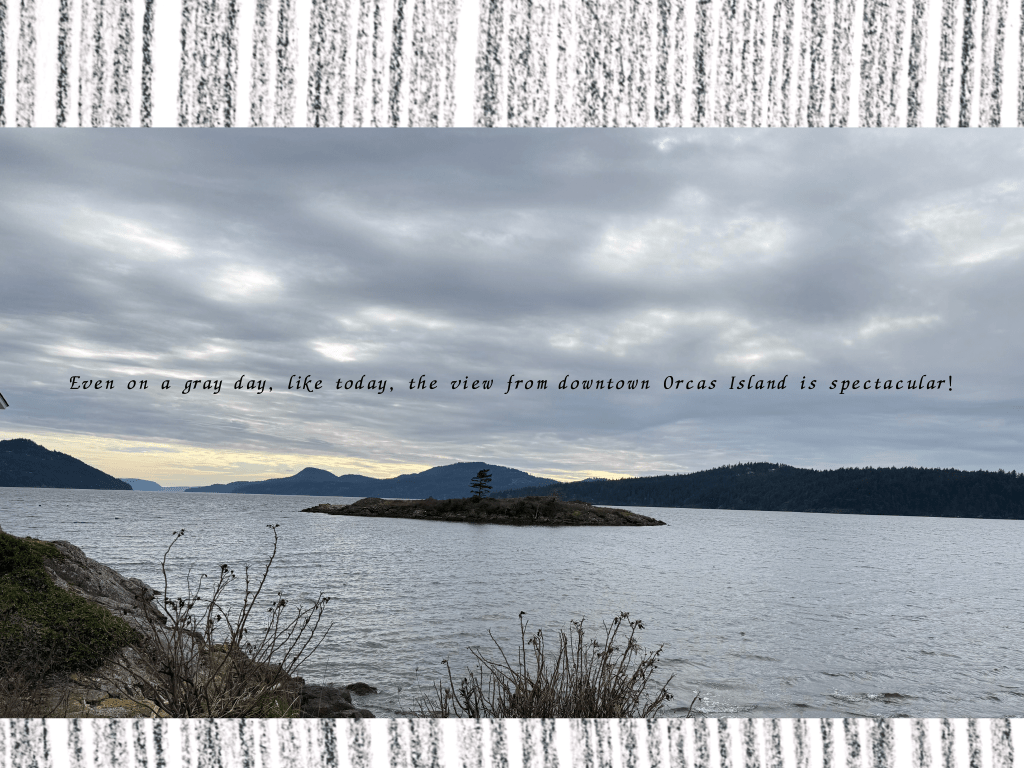
Orcas Island, Washington
98245
USA

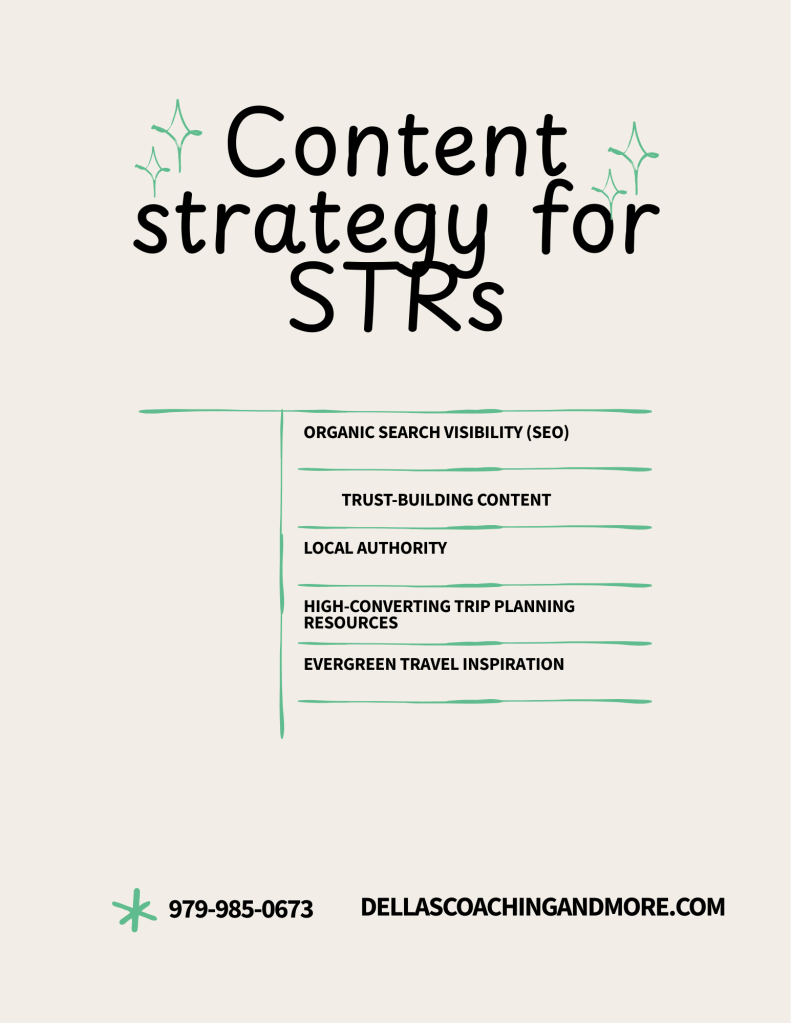
SEO Content Marketing for Short-Term Rentals: A Complete Guide

Short-term rental marketing has become increasingly competitive. With rising ad costs and crowded booking platforms, relying solely on paid traffic or OTAs limits long-term growth. That’s where SEO content marketing for short-term rentals comes in.

By creating search-optimized, traveler-focused content, short-term rental businesses can attract guests earlier in the booking journey, build trust, and generate consistent, organic bookings over time.

This guide breaks down exactly how SEO content marketing works for short-term rentals—and how to use it effectively.


What Is SEO Content Marketing for Short-Term Rentals?

SEO content marketing combines search engine optimization with strategic content creation to attract travelers through organic search.

Instead of promoting listings directly, SEO content focuses on:

  • Answering traveler questions
  • Highlighting destinations and experiences
  • Building authority around a location or niche

For short-term rentals, this often includes:

  • Destination guides
  • Local activity roundups
  • Seasonal travel content
  • Booking-related informational posts

All optimized to rank in search engines and guide users toward booking.


Why SEO Content Matters for Short-Term Rental Businesses

Most travelers don’t start with “book now.” They begin with research.

Examples:

  • “Best places to stay near [destination]”
  • “Things to do in [location]”
  • “Best time to visit [island/city]”

SEO content allows you to show up before travelers are comparing listings.

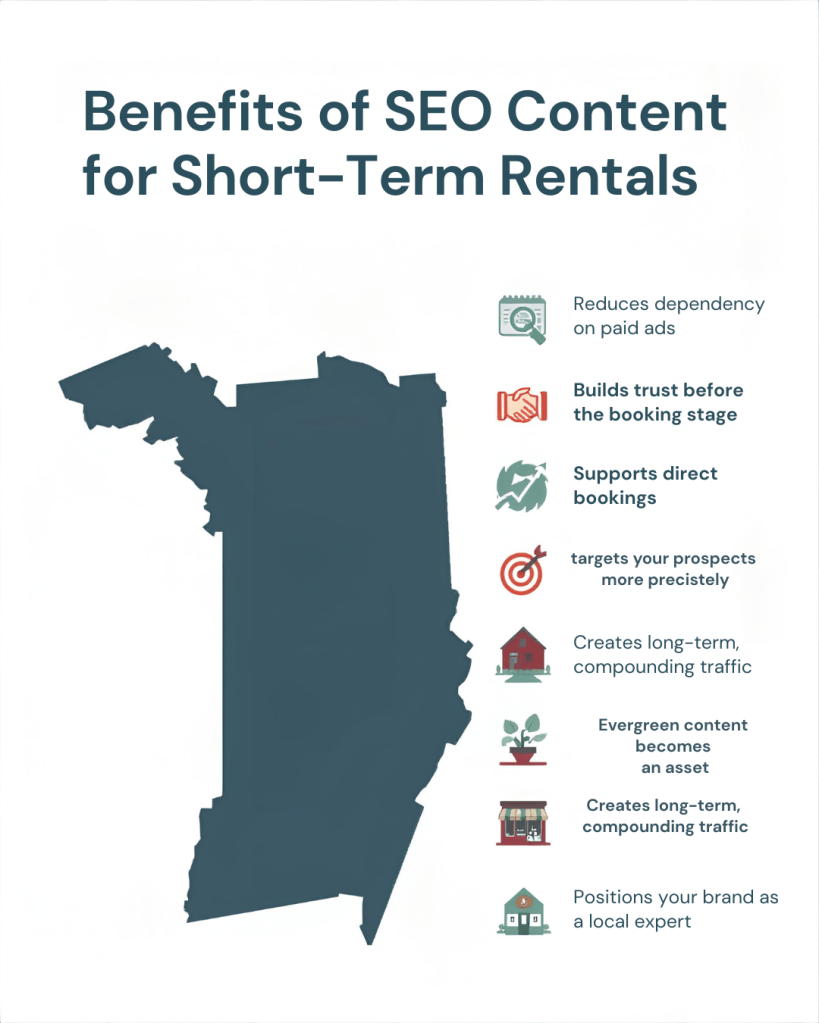
Benefits of SEO Content for Short-Term Rentals

  • Reduces dependency on paid ads
  • Builds trust before the booking stage
  • Supports direct bookings
  • Creates long-term, compounding traffic
  • Positions your brand as a local expert

Understanding Traveler Search Intent

Effective SEO content starts with search intent.

Short-term rental search intent typically falls into three categories:

1. Informational Intent

Users researching:

  • Things to do
  • Local tips
  • Travel planning

Examples:

  • “Things to do in [destination]”
  • “Is [destination] worth visiting?”

2. Commercial Intent

Users comparing options:

  • “Best short-term rentals in [destination]”
  • “Where to stay in [location]”

3. Transactional Intent

Users ready to book:

  • “Book short-term rental in [destination]”

Your SEO content strategy should prioritize informational and commercial intent, then internally link toward booking or listing pages.


Best Types of SEO Content for Short-Term Rentals

Destination Guides

Foundational content that introduces your location.

Examples:

  • “Complete Guide to Visiting [Destination]”
  • “First-Time Visitor Guide to [Location]”

These pages often become high-traffic evergreen assets.


Local Experience Content

Content that showcases what makes your area unique.

Examples:

  • “Best Beaches Near [Destination]”
  • “Top Restaurants in [Location]”
  • “Hidden Gems Only Locals Know”

This content builds trust and demonstrates local expertise. It also elevates your brand when accompanied by great reviews! In 2026, experts such as Steve Schwab, CEO of Vacasa/Casago, say the focus for short-term rentals should be on operational excellence. One way you demonstrate operational excellence is through consistently positive reviews, as well as responding to negative reviews. Show your prospects that you offer a great experience, and that your team strives to correct issues immediately, and you will establish the positive brand image that accompanies operational excellence.

Seasonal Travel Content

Tourism is seasonal—your content should reflect that.

Examples:

  • “Best Time to Visit [Destination]”
  • “Winter Travel Guide to [Location]”
  • “Summer Events in [Destination]”

Update these annually to maintain rankings.


Booking-Support Content

Content that helps users choose you.

Examples:

  • “Where to Stay in [Destination]”
  • “Short-Term Rental vs Hotel in [Location]”
  • “Best Areas to Stay in [City/Island]”

These posts should include strong internal links to booking pages.


Keyword Research for Short-Term Rental SEO Content

Keyword research for tourism SEO focuses on:

  • Location-based keywords
  • Long-tail travel queries
  • Experience-focused searches

Tips:

  • Combine destinations with experiences (“kayaking in [destination]”)
  • Look for keywords with clear traveler intent
  • Don’t ignore lower-volume keywords—they often convert better

Avoid over-optimizing for “short-term rental” keywords only. Travelers search for experiences first, accommodations second.


On-Page SEO Best Practices for Rental Content

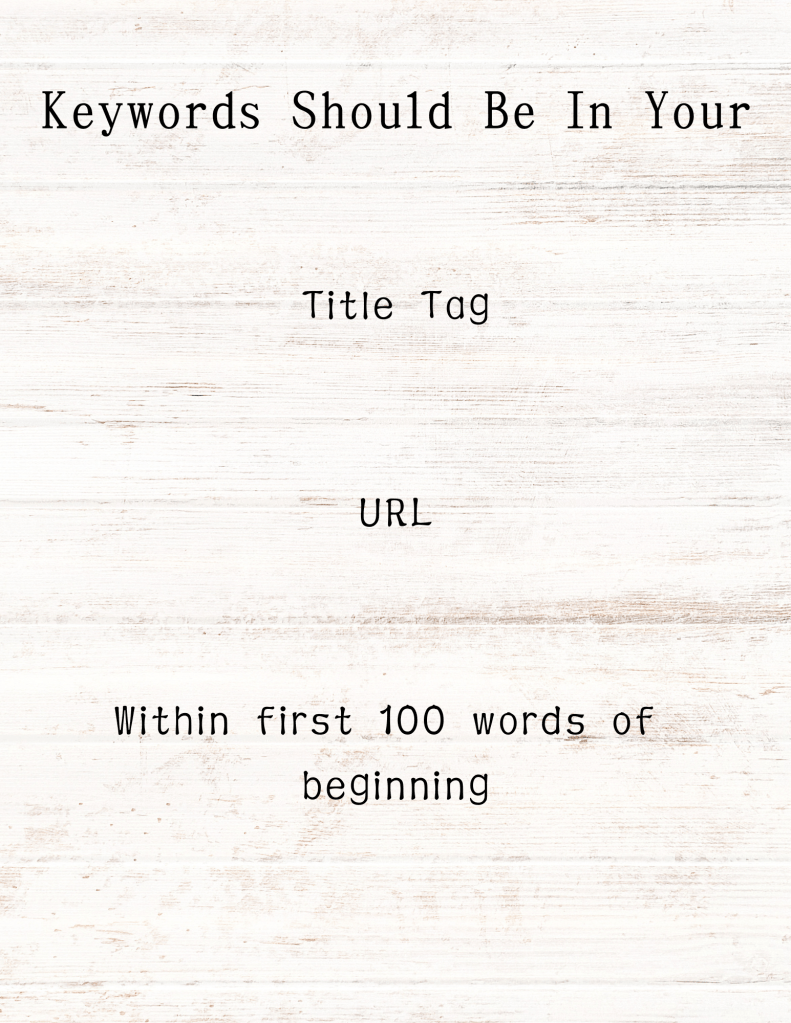
Every post should include:

  • One clear primary keyword
  • Optimized title tag and meta description
  • Proper heading structure (H1–H3)
  • Internal links to:
    • Destination pillar pages
    • Booking or listing pages
  • Optimized images with descriptive alt text

Content should be helpful first, optimized second.


Internal Linking: Turning Content into Bookings

Internal linking is where SEO content drives real results.

Best practices:

  • Link informational content to booking-focused pages
  • Use natural anchor text (“places to stay in [destination]”)
  • Link related blog posts together to build topical authority

This structure helps search engines understand your site—and guides users closer to booking.


Measuring SEO Content Success for Short-Term Rentals

SEO content success isn’t just traffic.

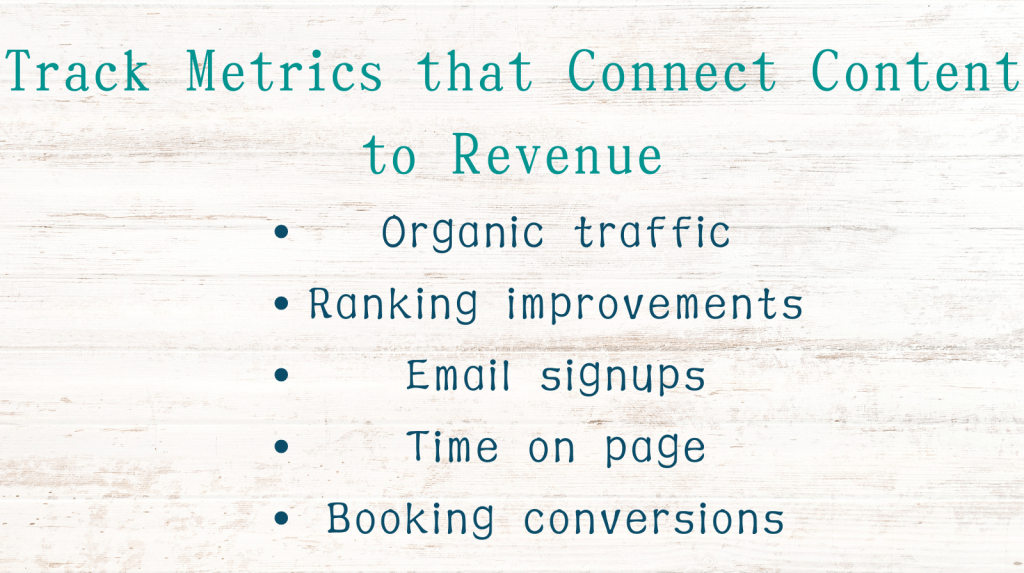
Key metrics:

  • Organic traffic growth
  • Rankings for destination keywords
  • Time on page
  • Clicks to booking pages
  • Direct bookings influenced by content

Results compound over time, especially with consistent publishing and updates.


SEO Content Is a Long-Term Asset

Short-term rental SEO content isn’t about quick wins—it’s about owning your destination online.

When done correctly, SEO content:

  • Works year-round
  • Supports direct bookings
  • Reduces marketing costs
  • Builds lasting authority for your brand

Want Help Building SEO Content for Your Short-Term Rental?

If you want to attract travelers earlier, rank for destination searches, and turn content into bookings, SEO content marketing is one of the most effective strategies available.

Explore more resources in the Destination Marketing SEO pillar or reach out to learn how a tailored SEO content strategy can support your short-term rental business.

Orcas Island, Washington
98245
USA

24 Blog Post Ideas to Showcase Your Vacation Rental

Creating fresh content for your vacation rental website doesn’t have to mean reinventing the wheel. In fact, some of the most effective blog posts are the simplest — stories, photos, and experiences that show guests exactly what it’s like to stay at your property and explore the surrounding area.

Below are 24 blog post ideas you can rotate through all year long. Many of these can become recurring series, seasonal features, or even social media content — helping you get more mileage out of every post.

Show Off Your Property

1. A Photo Tour of Your Vacation Rental

Create a short visual walkthrough of your home, or spotlight one room or property at a time. This works especially well as a monthly series and helps guests picture themselves staying with you.

2. A Video Walkthrough of Your Rental

Film a guided tour of the interior of your home. Focus on layout, light, and comfort — and avoid filming identifying exterior details for privacy and security.

3. Feature Each Bedroom

Dedicate a post to each bedroom, highlighting views, natural light, bed types, linens, and the overall vibe. This helps guests choose the room that best fits their needs.

4. Highlight the Kitchen

Show how your kitchen supports real stays — from coffee mornings to family dinners. Mention appliances, cookware, and space to gather. One often-overlooked detail on listings is the type of coffee maker in the home. This is super important to most coffee drinkers, and they might need to know before making it to your town, or at the very least, before heading to the rental once in town. For example, if your house is in a rural area, and people must drive a long distance to get to the home from town, those guests probably will not want to go back into town for coffee, after checking in at 4. Do what you can to make the guest’s stay and the shopping and preparation for it easy as possible.

5. Spotlight the Master Bathroom

Luxurious bathrooms sell stays. Highlight soaking tubs, tile work, lighting, and plush towels with descriptive storytelling. Guests often book homes that are at least slightly better than their own, and bathrooms are one of the things that really grab their attention.

6. Feature the Backyard or Outdoor Space

Pools, patios, fire pits, gardens — outdoor areas are often a deciding factor. Use photos or video to show how guests can relax outside. This can be a major selling point for your short-term rental, so be sure that you cover whether your Orcas Island rental has a hot tub, or your Phoenix rental has a pool. Your guests will want different things, depending on the area in which they stay. When featuring the outdoor space, remember to let guests know if some amenities are only availabe during certain seasons.

For example, one of the houses I manage on Orcas Island has the perfect backyard for entertaining, but the rainy time of the year is not a desirable time to sit on an uncovered porch, and the rain ruins his seat cushions, so they are only available during the spring and summer months. Obviously, we don’t take photos of the outdoor space without the cushions on them, but there is plenty of verbiage in the listing to let guests know what to expect.

Share Guest Experiences

7. Guest Trip Highlights

Ask guests to share one thing they loved most about their stay or the area. Compile these into a feel-good post that also highlights local attractions. For example, one of my clients owns the only bicentennial farm on Orcas Island, his home is one a few waterfront properties with a flat path to the beach, and he has a wedding venue that is often used by celebrities.

Compile your best reviews, and don’t be afraid to take a picture of your handwritten guest book when you host that amazing wedding on your property. This sets you apart from the rest. Handwritten sentiments evoke more emotion than typed ones, and a picture of the handwritten praise of your rental is a great addition to your social media and blog.

8. Guest Photos from Their Stay

Invite guests to submit photos (with permission). These authentic images build trust and double as social media content. Using the example above, when my client with the wedding venue hosts celebrity weddings, photos are posted on his wedding venue site, showcasing what the property can be used for. Use the photos and videos that make your listing shine!

9. Feature Your Best Reviews

Turn glowing reviews into a blog post or short video. Group them by theme — comfort, location, amenities, or hospitality.

10. The Worst Review You’ve Ever Received

Tell a transparent, human story about a tough review — and how you handled it. This builds credibility and shows professionalism. Try to avoid skirting responsibility for the issues in your home. Own them, and let your prospects know that you did what you could for your guests to make things right, and that the issues have been fixed.

Tell Your Story as a Host

11. Why You Love Hosting Guests

Share what motivates you as a host and the experience you aim to create. Guests book people as much as properties. For me, I am motivated by the promise that getaways hold- you can completely change your life during the course of a 5-day stay. I try to recreate my best travel memories for my guests, when possible.

For example, my 2 best vacations are my favorites for different reasons, and the type of vacation varies. My favorite solo trip was to Maui, Hawaii. But, my favorite family trips are tied- 2 different Disney cruises, taken with my ex’s family, hold the top spot for family trips.

These two trips showed me the potential of a vacation, and that drives me to create positive guest experiences for my guests.

12. How Your Vacation Rental Began

Tell the origin story of your rental — why you started, what inspired you, and how it’s evolved. For example, is your home newly built? Is it a historic home? Was it originally a family home that you now host families in? Why?

Doing this also gives you the opportunity to sell your experience as a family experience, especially if you have some negative reviews on the house. For example, one of the homes I manage had a flood of negative reviews recently because many guests, one after the other, said the house was creepy and they immediately left upon arrival because they thought it was haunted.

This house does better when guests know up front that it is a no-frills experience in a rustic cabin on the waterfront. While it might have been easier to get bookings if the online photos of the home didn’t include the hallway full of family photos, which is one of the first things guests see upon entry, it is better for guests to know up front what they are getting. Do what you can to accurately reflect the state of your rental, and it will make a huge difference!

You may be asking why the hallway is full of family photos. After all, it’s a vaction rental. The hallway is full of family photos because the home was originally built and lived in by my client’s mother, who then made it into a Bed and Breakfast with access to the whole home, and the mother delivered meals to the guests, while staying at her sister’s house on an adjoining property.

The home was offered that way for over 20 years, and many of the return guests still come to the home every year. It has now been 30 years since the home was first offered as a Bed and Breakfast, and not much has changed in the home, aside from replacing broken items, upgrading linens and some minor decor changes in the living room and bedrooms. The home is well-maintained, and it offers a gorgeous view that many people want, but they don’t want the older looking feel of the home or all the family photos.

The family still offers the home as a vacation rental, but there are certain things they want to stay the same, which is their choice. The challenge was to make sure guests knew exactly what they were getting ahead of time. They needed to know that the gps directions would bring them down a very rough road and take twice as long to get to the home. They needed to know that 4-wheel drive is necessary in the colder months, and they needed to know it is a family home, which is why the hallway has photos and awards in it- because, for them, offering the home as a vacation rental was their way of honoring the mother’s memory and what she built for her guests. They want things the same, so we do what we can to ensure guests know what to expect.

13. How You Built Your Vacation Rental Website

Walk through your journey of creating your site, including tools you used, challenges you faced, and lessons you learned.

14. A Day in Your Life as a Host

Show the behind-the-scenes work that goes into creating a great stay — from guest communication to property care. For example, what takes place during a turnover?

  • professional cleaning?
  • Hotel-level amenity replenishment?
  • Is the property thoroughly inspected by a property manager before guest arrival to ensure that all maintenance and housekeeping are completed properly?

15. Your Biggest Failure (and What You Learned)

Honest storytelling resonates. Share a mistake and how it made you a better host. For example, maybe you once thought the carpet in your rental would dry a bit on its own after a flood, not knowing how wet it was, which led to a musty smell and several reviews about the musty smell in the home.

You might have learned that it is best to take care of wet items right away, and that interrupting the guests’ stay by removing carpet so it isn’t sitting wet while they are there is better than not taking the carpet up, thinking you are avoiding disturbing the guests.

16. Your Biggest Success

Celebrate a milestone, achievement, or moment you’re most proud of as a vacation rental owner. For example, one of the homes I manage hosted a small, private wedding on the beach, outside the home. These guests posted their photos and reviews on the website and in the home. The homeowners were very pleased to read the guest book the next time they came to their home because there was a long journal entry, detailing the day’s events, throughout the wedding. And, every year since they were married, the family returns to the home on their wedding anniversary.

The homeowners gave someone something they really wanted, and it was special to those guests- special enough to create return visitors, who almost become family after visiting the home year-after-year.

Highlight Improvements & Renovations

17. Before & After: Kitchen Renovation

Renovation stories are highly engaging and show how much care you put into the guest experience. They also allow you to address guest complaints that are online by responding to the guest who complained, letting them know the issue has been taken care of.

This is especially important if the home failed the guests unexpectedly- like if there is a suspected gas leak in the oven, and the guests need to vacate the property. Make sure guests know there is a new oven and that the home has been inspected for gas leaks and is ok.

18. Before & After: Bathroom Renovation

Bathroom remodels can make a huge difference in a home. When I first started working with short-term rentals, there was a house I managed that was only open seasonally, due to treacherous roads to the house in the colder months. Unfortunately, they had been unable to find someone to fix the flooring in one bathroom and the ceiling in the one below it for many years. The stain on the floor was intense, although the one on the ceiling below might not have been as noticeable to guests. However, I knew that we had a window of time, right after the home closed for the cold months, when we could get a contractor in to fix the bathrooms.

Bear in mind, the homeowners had given up at this point. They had tried every contractor they could find with no luck, so I decided to stop looking at the problem like we still used phone books. I went online and found several contractors with great reviews in the area, and I found one of the best contractors that I have worked with. He remodeled the bathrooms, and we posted the pictures to the listing. The new bathrooms were gorgeous!

The was fully booked the next summer, and the reviews were between 4 and 5 stars, opposed to between 2 and 4 stars. The remodel made a huge difference because it isn’t only about the time the guests are in the house, and it isn’t only about people finding the property and booking. We need both of those items to work together to get the best possible results.

19. Before & After: Bedroom Refresh

Bedroom refresh photos are great, especially when you get complaints of a lumpy mattress, stained duvet cover, or stained sheets. If you update the bedrooms in your rental, be sure to post fresh photos, letting your guests know.

20. Before & After: Backyard Landscaping

Backyard landscaping, including the presence of water features, like hot tubs and pools, is a great before-and-after photo comparison. You can really capture the improvements to the listing using these before-and-after photos.

For example, one of my homeowners has been renting his home for 10 years. He keeps up with maintenance to ensure the home looks as new in person as it does in photos, and he just installed a new sauna that faces the ocean, where lots of sea creatures are spotted. The new sauna photo was added to the listing, and the before-and-after photos went online and in the house to ensure guests see the effort he puts into making his home comfortable and enjoyable to the guests he hosts.

These posts build trust and visually demonstrate your commitment to quality.

Feature Your Team

21. Meet the Team

Introduce the people who help make stays seamless — cleaners, property managers, gardeners, or maintenance pros. While I have many wonderful housekeepers on my staff and the most handy maintenance man I’ve ever worked with, I try to respect their privacy and not identify them online unless they allow it.

While I am ready to own responsibility for any repercussions of their actions, I do not share the burden of responsibility for my staff with them, with few exceptions. Mostly, I don’t call out my team in complaints that are online. If they make a mistake or miss something when cleaning, I stick to the “praise in public, punish in private” rule (although, I prefer to coach my staff, opposed to punish them). I would rather coach my team members privately and do what I can to help them correct their mistakes or learn to do things in a better way.

In the current offseason, I have 5 housekeepers on my team and 1 maintenance tech. They all play their part in getting the rentals in my portfolio ready for guests, but some more than others. I refer to my maintenance tech as my right hand and one of my housekeepers as my left hand. They have been with the company longer than I have, and they are available for guest issues, as well, making them a vital part of my team, with whom I share credit and responsibility.

22. A Day in the Life of Your Staff

Show how much care goes into preparing the home before every guest’s arrival. You can post your pre-guest arrival checklist here.

Promote Amenities & Services

23. Top Amenities Guests Love

Highlight standout features — pools, fireplaces, soaking tubs, fast Wi-Fi, or kid-friendly extras. Speaking of Wi-Fi, if your rental has Wi-Fi, but it is intermittent or unreliable, due to the remote location of the rental, be sure that is obvious to guests when booking, and don’t be afraid to email them letting them know, after they book.

You want your guests to know if there might not be reliable Wi-Fi, since intermittent Wi-Fi will cause guests to reflect negatively upon every aspect of the stay. So, while it’s important to be sure your guests know what you do have, it is equally important that they know what you don’t have, especially if it’s Wi-Fi.

Doing this will reduce the number of scathing online reviews about the Wi-Fi and likely save you money on refunds, since guests will demand a refund for Wi-Fi- sometimes, even if they are told ahead of time there is no Wi-Fi.

24. Additional Services You Offer

Airport pickup, concierge services, and local guides — these details can influence booking decisions. For example, my guests receive a large discount on whale watching and kayak tours on the islands we serve, as a perk for booking a stay with us. They are also texted if early check-in is available, and they are offered late check-out if it is available.

Final Tip: Make the Local Area Part of Every Post

No matter which idea you choose, always connect it back to the destination. Mention nearby attractions, seasonal activities, restaurants, or views. This strengthens your SEO, supports destination-based searches, and helps guests imagine the full experience.

When done consistently, these posts don’t just fill a blog — they build trust, reduce OTA dependency, and turn your website into a booking asset.

Orcas Island, Washington
98245
USA

How to Write SEO Blog Posts That Rank (Step-by-Step)

To succeed as an SEO content marketer, you must balance expertise, proof, and search demand. Writing a blog post that ranks on page one in 2026 requires moving beyond simple word counts and focusing on high-intent informational keywords that position you as an authority in your niche.

This step-by-step guide walks you through the foundational process of creating content that satisfies both search engines and human readers.

Step 1: Identify Search Intent

Before writing a single word, you must understand search intent—the “why” behind a user’s query. To rank effectively, your content must match what the user is looking for, whether it is educational information, a specific product, or a guide. If your post doesn’t align with the intent of the top-ranking results, it will struggle to gain traction regardless of how well it is written.

Step 2: Conduct Keyword Research

Effective keyword research for bloggers involves finding a balance between search volume and competition. Focus on:

Primary Keywords: Your main topic (e.g., “SEO blog writing”).

Secondary Keywords: Related terms that provide context (e.g., “on-page SEO for blogs,” “content marketing strategy”).

Niche Relevance: Especially if you are in a specialized field like destination marketing or short-term rentals, targeting lower-competition, high-relevance terms helps you rank faster.

Step 3: Structure for Readability and Depth

Search engines favor content that is well-structured and easy to navigate. Use a clear hierarchy of headings (H1, H2, H3) to organize your thoughts:

H1: Your main title, including your primary keyword.

H2s: Sub-topics that break down the process (e.g., “How SEO Content Marketing Works” or “Measuring Success”).

Formatting: Use bullet points, short paragraphs, and bold text to improve readability for “scanners”.

Step 4: Execute On-Page SEO Best Practices

Once your content is drafted, optimize the technical elements to ensure search engines can crawl and understand your post:

URL Slugs: Keep them short and keyword-rich.

Meta Titles and Descriptions: Write compelling snippets that encourage clicks from the search results page.

Internal Linking: Follow a hub-and-spoke model. Link back to your SEO Content Marketing Pillar Page and connect your new post to at least 1–2 other related articles to distribute “link equity” across your site.

Step 5: Plan for Regular Updates

SEO is not “set it and forget it.” High-ranking content requires a content refresh strategy. Plan to update your posts every 6–9 months by adding new keywords, refreshing outdated information, and checking your internal links to maintain your rankings.


——————————————————————————–

About the Author Della O’Brien is an SEO content marketer and blog writer with experience in SEO-driven content marketing since 2019. She specializes in creating blog content that drives traffic, engagement, and bookings, specifically within the destination marketing and short-term rental niches.

Ready to master your strategy? Explore our suggestions for 24 Blog Post Ideas to Showcase Your Vacation Rental to learn how to build a high-performing blog from the ground up.